In remote areas or locations with unstable grid power, users want faster battery charging. When sunlight fades on cloudy days or sunset arrives, they hope the generator can kick in automatically to top‑up the battery bank together with remaining PV power. Not all hybrid inverters support dual‑source concurrent charging. Some models only allow one charging source to work at a time and switch back‑and‑forth. This article breaks down how generator‑inverter charging works, why our 12 kW US‑standard hybrid inverter supports simultaneous charging, and the real‑world benefits for your solar project.
How Generator and Hybrid Inverter Charging Works?
To understand simultaneous charging, we need to look inside hybrid inverter hardware.
A hybrid energy storage inverter contains two independent charging subsystems.
First, the MPPT PV charging unit: it takes DC power from solar panels, and converts it into regulated DC current to charge the battery bank. This circuit works whenever sunlight is available.
Second, the AC‑DC rectifier charging unit: it accepts AC input. This AC port supports both utility grid and generator input (generator and mains share the same AC terminal). The rectifier converts AC power into DC for battery charging.
These are two separate electrical paths.
On cheaper inverters, firmware logic restricts only one charger to run. When solar is active, generator charging is blocked; when solar drops, the unit switches over to generator. They cannot add charging currents together. This is time‑sharing charging, not simultaneous charging.
For true dual‑source charging, both charging circuits must be allowed to output charging current toward the battery bank at the same time, with overall current limited by hardware and battery BMS protection.
Why Our 12 kW US‑Standard Hybrid Inverter Supports Dual‑Source Charging?
Our SUNBOOST 12 kW US hybrid inverter (GES48120M220‑500XP) is built for real‑world off‑grid and backup scenarios.
1.It has two independent charging hardware branches: dual‑tracker MPPT solar charger, plus built‑in AC‑DC rectifier charger.
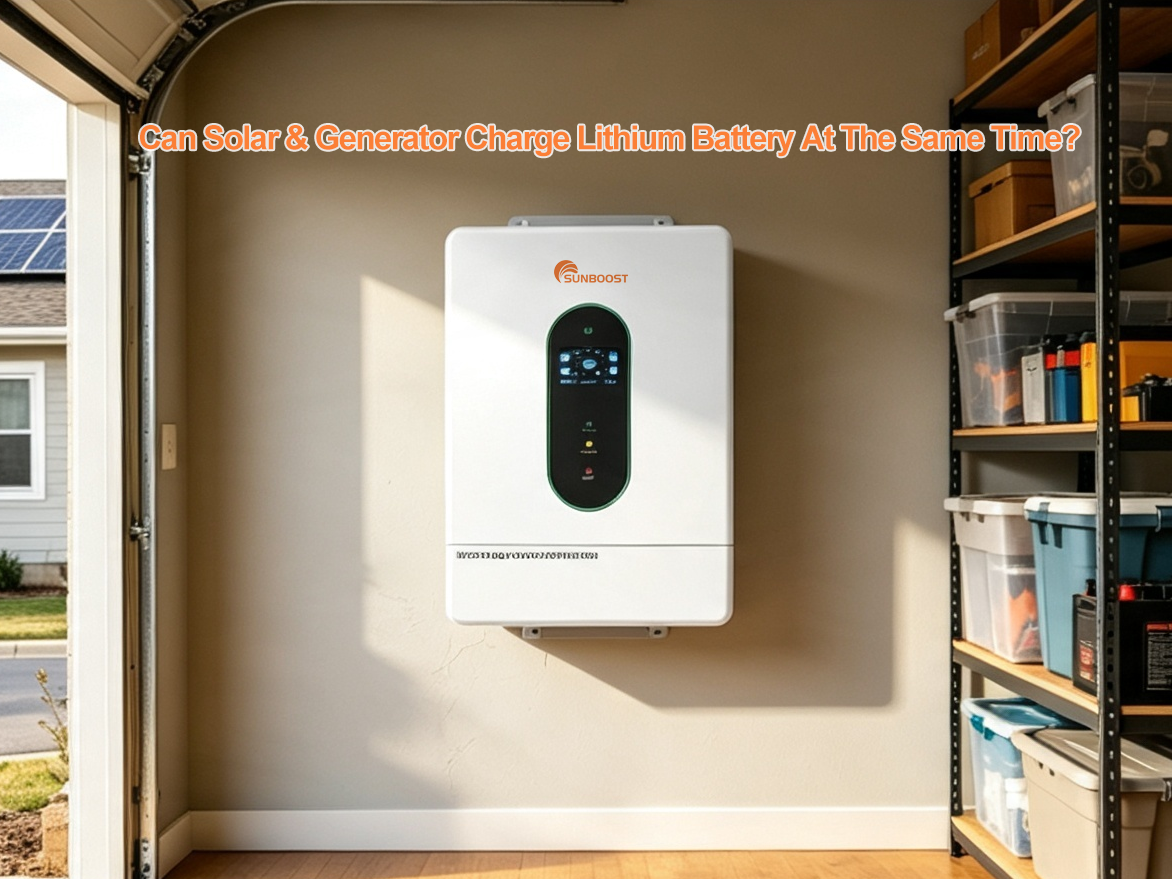
2.Generator and utility grid share one AC input terminal. No extra hardware is needed to connect a generator.
3.Firmware permits PV charging and AC generator charging to operate concurrently. Solar current and generator‑derived charging current add together to feed the battery bank.
4.Built‑in protection works with lithium‑ion battery BMS. Total charging current will not exceed the safe maximum value defined by the inverter and battery, preventing over‑charging risk.
5.It supports up to 6‑unit parallel expansion. Even in multi‑inverter systems, dual‑source charging function remains available.
When the sun is weak but not fully gone, solar still contributes charging power, and the connected generator supplements extra charging current automatically. No manual switching is required.
Key Practical Advantages for End‑Users
Faster battery charging cycles
Cloudy weather, short daylight hours or winter conditions reduce solar yield. Adding generator charging in parallel cuts battery full‑charge time. You get more stored energy in less time.
Suitable for off‑grid homes & workshops
For sites without stable utility grid, solar + generator dual‑source charging maximizes battery bank availability. You are less dependent on perfect sunny weather.
Simplified installation
Generator and grid reuse the same AC input port. Installers do not need extra wiring or separate terminals for generator connection.
Automatic operation
No human intervention. When PV output falls, the generator can supply charging power automatically. System keeps batteries well‑charged for critical backup loads.

Important note: The generator must supply stable AC voltage within the inverter’s rated AC input range.
Final
Generator and utility grid share one AC input terminal.
Concurrent dualsource charging shortens battery charging duration, improves energy reliability for offgrid and backup power projects, and simplifies generator installation. If you operate in areas with limited sunlight or unreliable grid, this function brings huge practical value to your solar storage system.