



Solar Charge Controllers
A solar charge controller serves as the intelligent regulator between photovoltaic panels and battery banks, ensuring efficient energy transfer while preventing overcharging and over-discharging. Utilizing advanced MPPT or PWM technology, it optimizes charging efficiency, extends battery lifespan, and provides comprehensive system protection for reliable off-grid and hybrid solar installations.


MPPT (Maximum Power Point Tracking) solar charge controllers maximize energy harvest by dynamically optimizing the match between solar panels and battery banks. By continuously tracking and adjusting to the panels’ peak power voltage, these advanced controllers can increase charging efficiency by up to 30% compared to conventional regulators, making them ideal for demanding off-grid and hybrid energy systems.
Advantages of MPPT Charge Controllers
MPPT (Maximum Power Point Tracking) charge controllers represent the most advanced technology available for solar charging systems. By continuously monitoring and adjusting the electrical operating point of the solar array, they ensure that the maximum possible power is harvested from the panels under all conditions. This intelligent regulation translates into significantly higher system efficiency, faster battery charging, and greater overall energy yield compared to traditional charge controllers, making them the preferred choice for serious off-grid and backup power applications.
MPPT controllers typically increase energy harvest by 15% to 30% over conventional PWM (Pulse Width Modulation) controllers. They achieve this by dynamically tracking the solar panel's maximum power point (Vmp), which varies with temperature and sunlight intensity. By converting excess panel voltage into additional charging current, they ensure that no available solar energy is wasted, especially during cloudy days, cold weather, or in less-than-ideal sunlight angles.
The high input voltage capability of MPPT controllers allows for the use of higher voltage solar arrays. This means panels can be connected in longer series strings, reducing wire gauge requirements and minimizing power loss over long distances from the array to the battery bank. This flexibility simplifies system design, lowers installation costs for larger setups, and makes it easier to expand the solar array in the future.
By extracting every available watt from the panels, MPPT controllers deliver more current to the batteries throughout the day. This results in noticeably faster charging times, bringing batteries to full capacity sooner. Furthermore, their sophisticated tracking algorithm is exceptionally effective in low-light conditions (e.g., early morning, late afternoon, or overcast skies), capturing energy that PWM controllers often cannot, thereby extending the useful charging window daily.
Beyond maximizing harvest, advanced MPPT controllers integrate comprehensive battery management protocols. They feature multi-stage charging (bulk, absorption, float, and often equalization) tailored to specific battery chemistries (LiFePO4, AGM, Gel, Flooded). This precise charging profile maximizes battery lifespan, prevents overcharging and undercharging, and includes critical protections against over-temperature, reverse polarity, and short circuits.
Modern MPPT controllers are equipped with communication interfaces (like Bluetooth, Wi-Fi, or RS485) and intuitive displays. They provide users with real-time and historical data on energy production, battery voltage, input/output currents, and system status. This visibility enables proactive system management, troubleshooting, and optimization, ensuring the solar power system operates at peak performance throughout its lifetime.
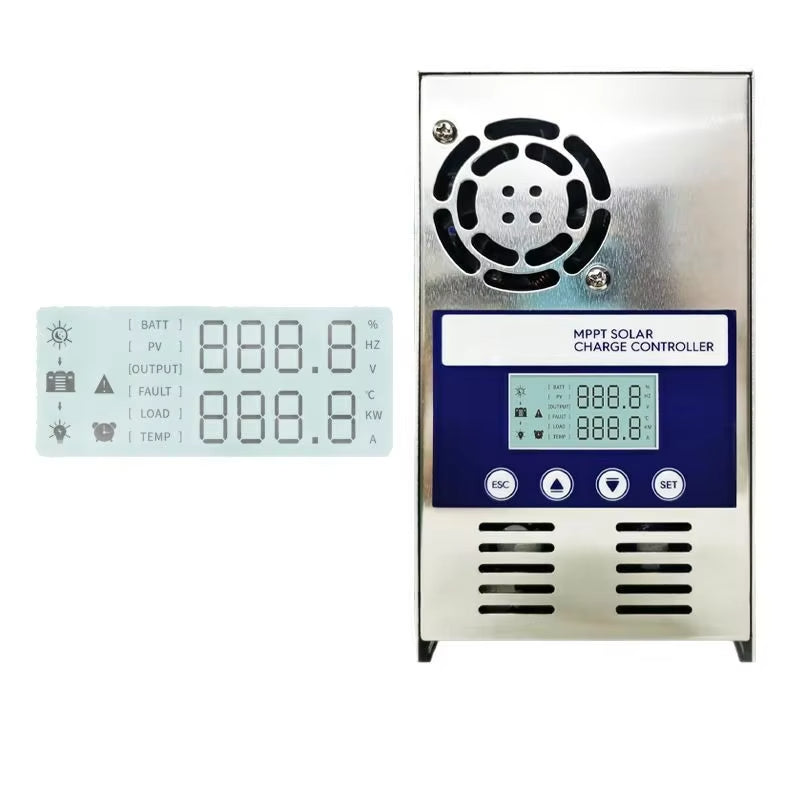
12/24/36/48V system voltage | 40A charging current
Upgrade Roadmap
LM-4048
This high-efficiency MPPT solar charge controller delivers up to 95% conversion efficiency with under 75°C temperature rise under full load. It features a color LCD for system monitoring, supports lithium and lead-acid batteries, and offers optional RS485 communication with MODBUS protocol for system integration.

12/24/36/48V system voltage | 60A charging current
Upgrade Roadmap
LM-6048
Combining a robust aluminum alloy housing with an active dual-fan design, this configuration delivers superior heat dissipation, resulting in lower operating temperatures and reliable performance.

12/24/36/48V system voltage | 40/50/60/80/100/120A charging current
Upgrade Roadmap
CM-40/50/60/80/100/120
This MPPT controller achieves over 95% efficiency with under 75°C temperature rise, featuring a color LCD and supporting both lithium and lead‑acid batteries. Optional RS485 (MODBUS) enables system integration.
Its extruded aluminum body and dual‑fan cooling lower operating temperatures, ensuring reliable long‑term performance.