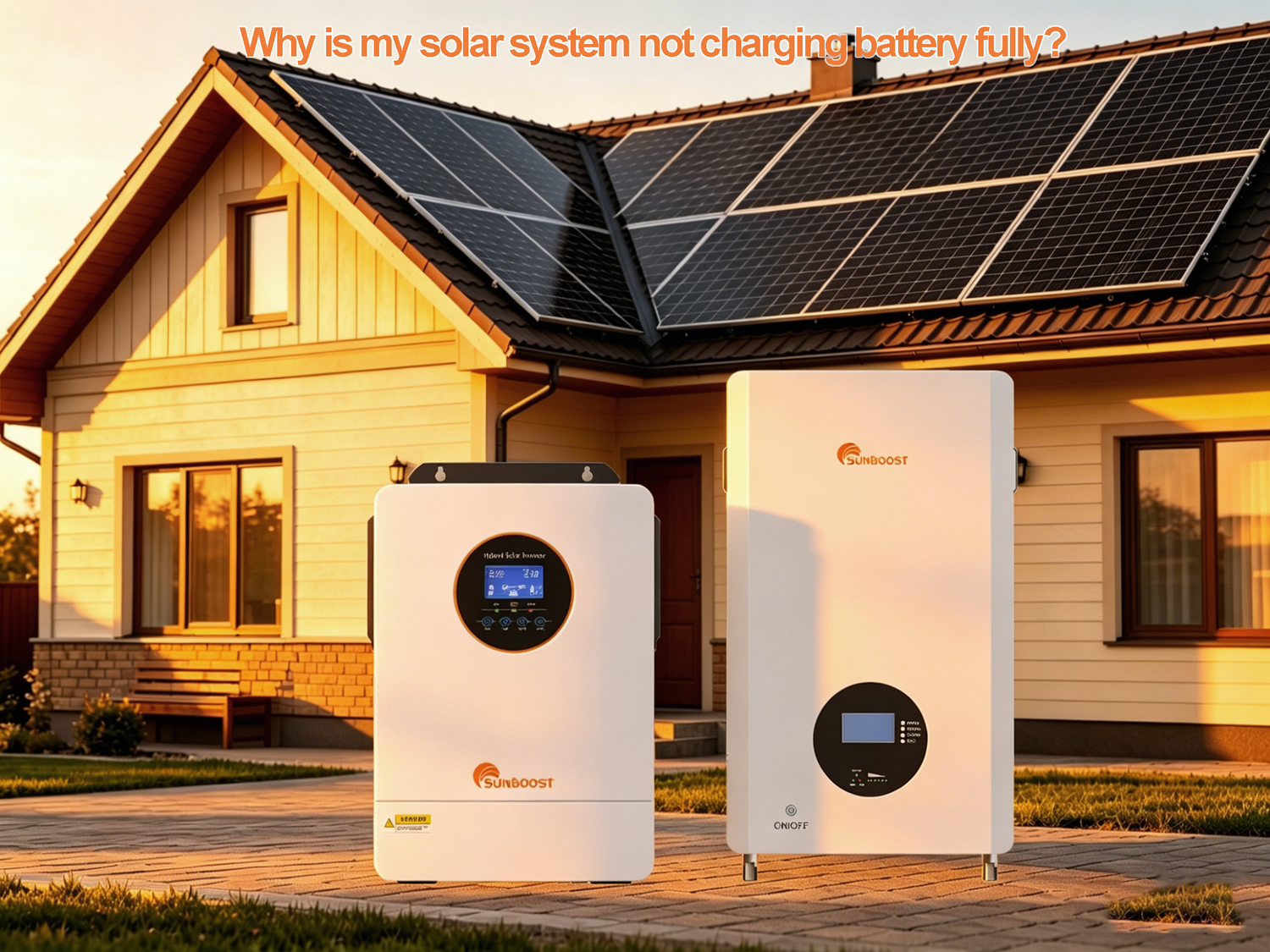
It is not uncommon for your solar batteries to never reach a 100% full charge. This widespread issue can stem from poor solar panel performance, improperly sized system configurations, incorrect inverter settings, or even unfavorable environmental conditions.
Taking the SUNBOOST 6.2K48-D120 hybrid solar inverter as an example, this guide provides step-by-step troubleshooting instructions. It focuses on prevalent faults such as insufficient PV array power and mismatched MPPT (Maximum Power Point Tracking) operating ranges, with detailed inspection procedures specifically for solar panels.
Whether you are a system owner or an installation technician, you can follow this guide to identify and resolve insufficient battery charging issues, and ultimately maximize the overall efficiency of your solar energy storage system.
The Frustration of a Never-Full Solar Battery
Imagine this: You wake up to a sunny day, check your solar system app, and see your battery is only at 70% charge—even though the panels have been working for hours. For anyone relying on a hybrid solar inverter system for backup power or off-grid living, this scenario is all too familiar.
Undercharging not only leaves you vulnerable to blackouts but also shortens the lifespan of your lithium-ion or lead-acid batteries, wasting the money you invested in renewable energy. The good news? Most undercharging issues are fixable once you identify the root cause.
Insufficient Solar Panel Power
The most obvious yet often overlooked reason your battery isn’t fully charging is that your solar panels simply aren’t producing enough power to meet the system’s needs. This is where understanding your inverter’s specifications becomes critical.
Let’s look at the SUNBOOST hybrid inverter specs to see how this works in practice:(like this picture)

6.2K48-D120
Max PV Array Power:7200W
MPPT Operating Voltage Range:120-450VDC
Nominal Battery Voltage:48V
Max PV Charging Current:100A
You can Check:
Verify PV Array Sizing: Compare your panel’s total wattage to the inverter’s max PV array power. For SUNBOOST’s 6.2K model, you need at least 6200W of panels (ideally 7200W for optimal performance) to reach full charging capacity.
Measure PV Voltage and Current: Use a multimeter to check the open-circuit voltage (Voc) of your panels. If your string voltage is below the 120VDC start-up voltage, the MPPT won’t even activate, leaving your battery uncharged. For example, a 48V battery system needs panels with enough cells to reach the minimum MPPT range.
Check for Shading or Dirty Panels: Even partial shading from trees or dirt buildup can drop panel output by 30-50%. SUNBOOST’s inverter has a wide MPPT range, but it can’t compensate for severely underperforming panels.
Environmental and Installation Issues That Kill Charging Efficiency
Even with the right equipment and settings, environmental factors can sabotage your charging performance.
1.High Temperatures
The SUNBOOST inverter’s operating temperature range is -10°C to +50°C. When the inverter or battery gets too hot:
The MPPT efficiency drops (from 99% to as low as 90% in extreme heat), reducing power conversion.
Lithium-ion batteries reduce their charging current to prevent overheating, stopping short of full charge.Fix: Ensure proper ventilation around the inverter and battery bank. SUNBOOST’s intelligent fan cooling helps, but installing the system in a shaded, well-ventilated area is key.
2.Overloaded Household Loads
If your home is using power faster than the solar panels can generate it, the inverter will prioritize powering loads over charging the battery.
Check:Try again after disconnecting the load.
3.Wiring and Connection Problems
Loose or undersized wiring between the panels, inverter, and battery can cause voltage drops that limit charging
Such as:
Combined with your actual configuration:
10pcs 580W monocrystalline solar panels + SUNBOOST 48V hybrid inverter + 5kW 48V lithium battery
SUNBOOST Inverter display screen:actual PV input voltage 176V, charging power only 403W.
Let's continue the analysis:
Single piece 580W solar panel standard open-circuit Voc voltage ≈36V.If 10 panels are fully connected in series correctly, the theoretical PV open-circuit voltage under strong sunlight should reach 10×36V=360VDC, which perfectly matches the nominal optimal operating voltage 360VDC of SUNBOOST inverter MPPT.
But your actual PV voltage is only 176VDC, which is equivalent to the voltage of only 3~4pcs 580W solar panels in series.
This means:Most of your solar panels are disconnected from the PV string, there is an open circuit fault in the series circuit, only 3-4 panels are effectively connected to the inverter MPPT input terminal, and the remaining panels are completely idle and not working.Low PV voltage directly leads to the inverter MPPT unable to track maximum power point, resulting in extremely low PV charging power, so the inverter cannot push enough power and cannot fully charge your 5kW battery.
Our SUNBOOST 6.2KW inverter has an MPPT operating voltage range of 120~450VDC, an optimal nominal operating voltage of 360VDC, and a maximum allowed open-circuit voltage of 500VDC. Our inverter boasts a conversion efficiency of over 90%, which is exceptionally high.
A summary of the step-by-step troubleshooting checklist for your system
1.Check Solar Panel Output
2.Inspect Wiring and Connections
3.Evaluate Load and Usage
Conclusion
Insufficient solar panel charge is a common problem, but it can be addressed by mastering the correct knowledge and using the right tools.
For users of SUNBOOST hybrid inverters, the key is to match your solar panel array to the inverter's specifications, ensure it is configured correctly, and follow the necessary steps to troubleshoot solar panel issues. Of course, this is only part of the problem; insufficient charging also involves battery and environmental factors.
Remember, your solar system is a interconnected ecosystem—every component, from the solar panels to the inverter and battery, needs to work in harmony. By following this troubleshooting guide, you’ll not only get your battery charging to 100% again but also extend the lifespan of your entire system, saving you money and ensuring reliable backup power for years to come.
If you’re still experiencing issues after trying these steps, consult a certified solar installer or reach out to SUNBOOST’s technical support for help with advanced diagnostics like firmware updates or component testing.