As a battery supplier, I deeply understand the importance of protecting these power sources from over-discharge. Over-discharge significantly shortens battery life, causes capacity loss, and in some cases, can even lead to complete battery failure. In this blog post, I will share some effective strategies for protecting batteries from over-discharge, using a real-world example:a SUNBOOST 11kW inverter paired with a 51.2V 300AH battery is set to stop working when the battery level drops below 5%.I hope this will be helpful to our customers and other friends.
Understanding Over - Discharge
Before delving into the protection methods, it's essential to understand what over-discharge is. A 48V battery works within a fixed voltage range. For standard 48V lithium iron phosphate batteries, the full charge voltage reaches approximately 51.2V, while the over-discharge cut-off voltage is set at around 40V. Once the voltage falls below this threshold, the battery goes into an over-discharge state.
Over-discharge will trigger abnormal internal chemical reactions, leading to permanent damage to electrodes and electrolyte. This will greatly weaken the battery's energy storage and output performance.
Using a Battery Management System (BMS)
Installing a Battery Management System (BMS) is a highly reliable solution to prevent 48V batteries from over-discharge. As a professional electronic module, the BMS oversees the whole charge and discharge cycle of the battery pack.
It is practically indispensable for 48V lithium batteries. The system keeps real-time track of every single cell voltage inside the pack. Once the overall pack voltage or any individual cell hits the preset cut-off point, the BMS will cut off the load automatically to stop further discharging.
Most standard BMS units come with extra safeguards too, including over-charge defense, short-circuit protection and temperature detection. These functions comprehensively shield the battery and improve its safety and service performance. We usually advise clients to pick 48V batteries with integrated BMS, or fit an external BMS for extra protection.
Why Over-Discharge Protection Is a Must for Your Solar System
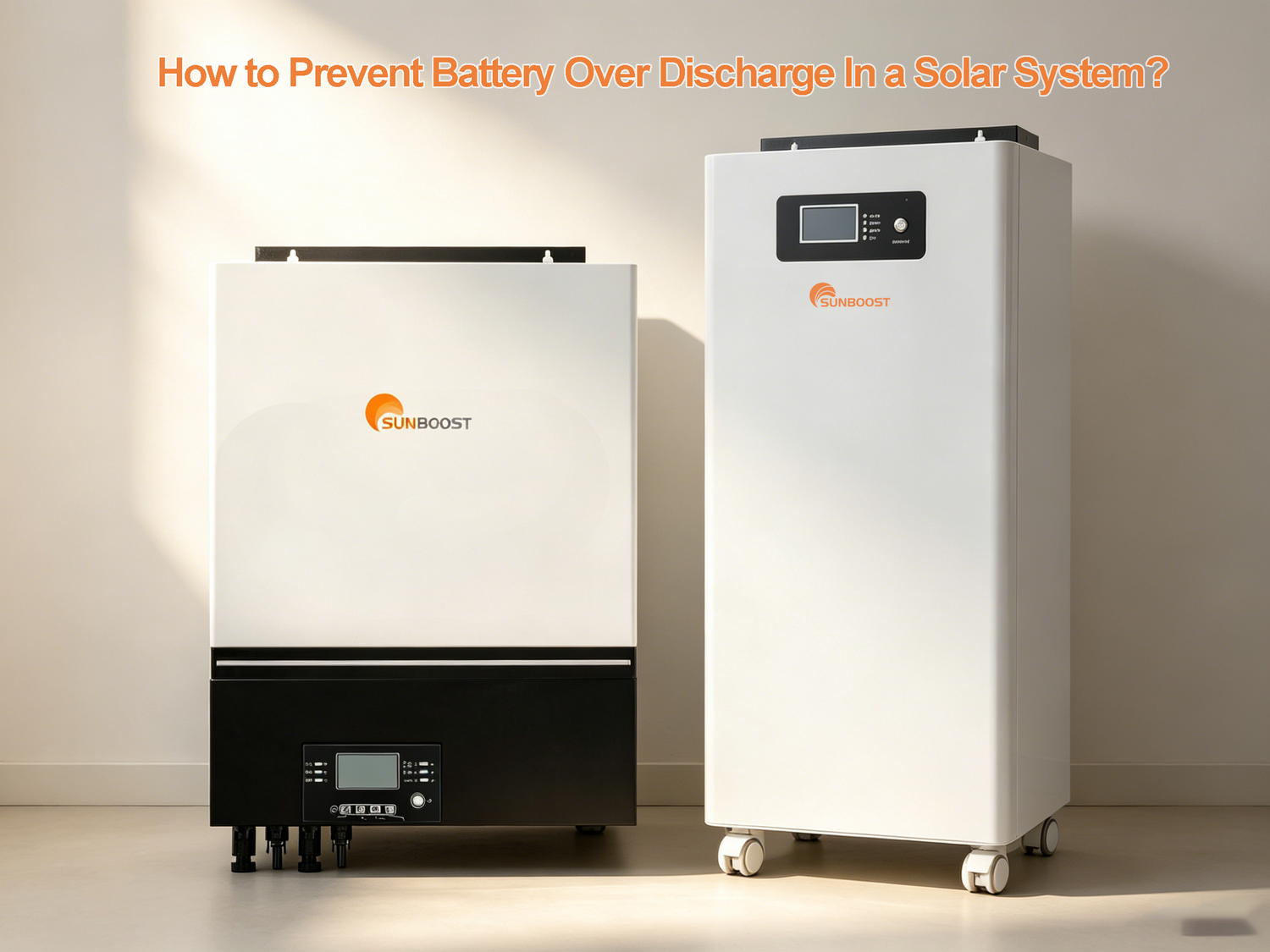
The combination of SUNBOOST 11kW high-power inverter and 15kWh battery is widely used in large households, small workshops and remote off-grid areas. The 11kW inverter can drive multiple high-power electrical devices at the same time, which means the battery discharges at a relatively high current. In rainy days or periods with insufficient sunlight, the solar panel cannot supply enough power to recharge the battery in time. If there is no effective over-discharge limit, the battery will be drained rapidly. Frequent deep discharge will not only greatly shorten the battery lifespan but also cause unexpected system shutdown, affecting your daily power consumption and normal work.
Many users mistakenly believe that the battery’s built-in protection can fully avoid over-discharge. In fact, for this complete solar system, the battery is fully controlled and managed by the matched SUNBOOST inverter.
The core anti-over-discharge function needs to be configured on the inverter side, rather than simply relying on the battery itself.
The key function we use is Low Voltage Disconnect (LVD). Once the battery voltage falls to the preset threshold, the inverter will automatically cut off the connection between the battery and loads, stop all discharging behaviors, and fundamentally prevent the battery from being emptied.
For example: SUNBOOST 11KW + SUNBOOST 51.2V 300AH lithium battery
All parameter adjustments must follow standardized procedures. Do not set parameters when the inverter is completely powered off. Please switch the inverter to Utility Grid Mode first to ensure stable power supply during configuration and prevent parameter loss or equipment anomalies.
Step-by-Step Inverter Parameter Settings
1. After shutting down the inverter, set it in AC power mode.
2. Open the inverter's 05 settings and set the Battery type to USE mode.
3. In the settings menu, item 29 is the low-voltage battery shutdown setting, which is set to 44V by default.

The factory default value of Parameter 29 for SUNBOOST 11kW inverter is 44V, which is a universal safe value adapted to most 48V battery packs. For daily household use, you can directly keep the default setting. If you have higher requirements for battery protection, you can fine-tune the value appropriately according to your battery type. When the real-time voltage of the 15kWh battery drops below the value you set here, the inverter will immediately disconnect the load circuit, stop the battery from continuing to discharge, and lock the battery in a safe voltage range.
After completing the settings, save all parameters and exit the menu. The over-discharge protection function will take effect immediately. The whole operation is simple.
Practical Supporting Tips to Strengthen Battery Protection
Reasonable inverter settings form the first line of defense against over-discharge. Combined with the following daily operation and maintenance methods, you can build a dual protection system to further optimize battery performance.
First, implement scientific load management. The 11kW inverter supports high-power output, but you should avoid connecting too many high-power devices to work at the same time. Excessive load will accelerate battery discharge speed, make the voltage drop sharply, and easily trigger frequent low-voltage cutoff. It is recommended to turn off non-essential electrical equipment during periods of insufficient solar power to reduce battery load.
Second, develop the habit of regular system monitoring. Check the real-time battery voltage and SOC data on the inverter panel every day. When you find the voltage is gradually approaching the cutoff value, reduce power consumption in time or wait for solar panels to recharge the battery. Timely observation can help you discover potential risks in advance.
Third, make the most of the BMS protection. If your 15kWh battery is equipped with a communication BMS, it will work synchronously with the SUNBOOST inverter. The BMS monitors the status of each single cell inside the battery, while the inverter controls the overall circuit. The two cooperate with each other to avoid abnormal discharge caused by single cell failure, and greatly improve the overall safety of the energy storage system.
Conclusion
For the matching system of SUNBOOST 11kW inverter and 15kWh battery bank, preventing battery over-discharge is a basic but crucial daily operation. The core logic is clear: the inverter undertakes the main control work of the battery, and the low voltage cutoff function is the most effective means to stop deep discharge.Cooperate with standardized load management and daily status monitoring, and your battery can maintain stable performance for a long time.
As a professional solar equipment brand, SUNBOOST is committed to providing reliable inverters and complete system configuration guidance. If you encounter problems in parameter setting, system matching or daily use, feel free to leave a message. We will provide you with professional technical support and solutions.