For homeowners in the United States, navigating the complexities of the electrical grid can be a daunting task. Unlike many other parts of the world that use a simple 230V single-phase system, the US relies on a unique 120V/240V Split Phase configuration.
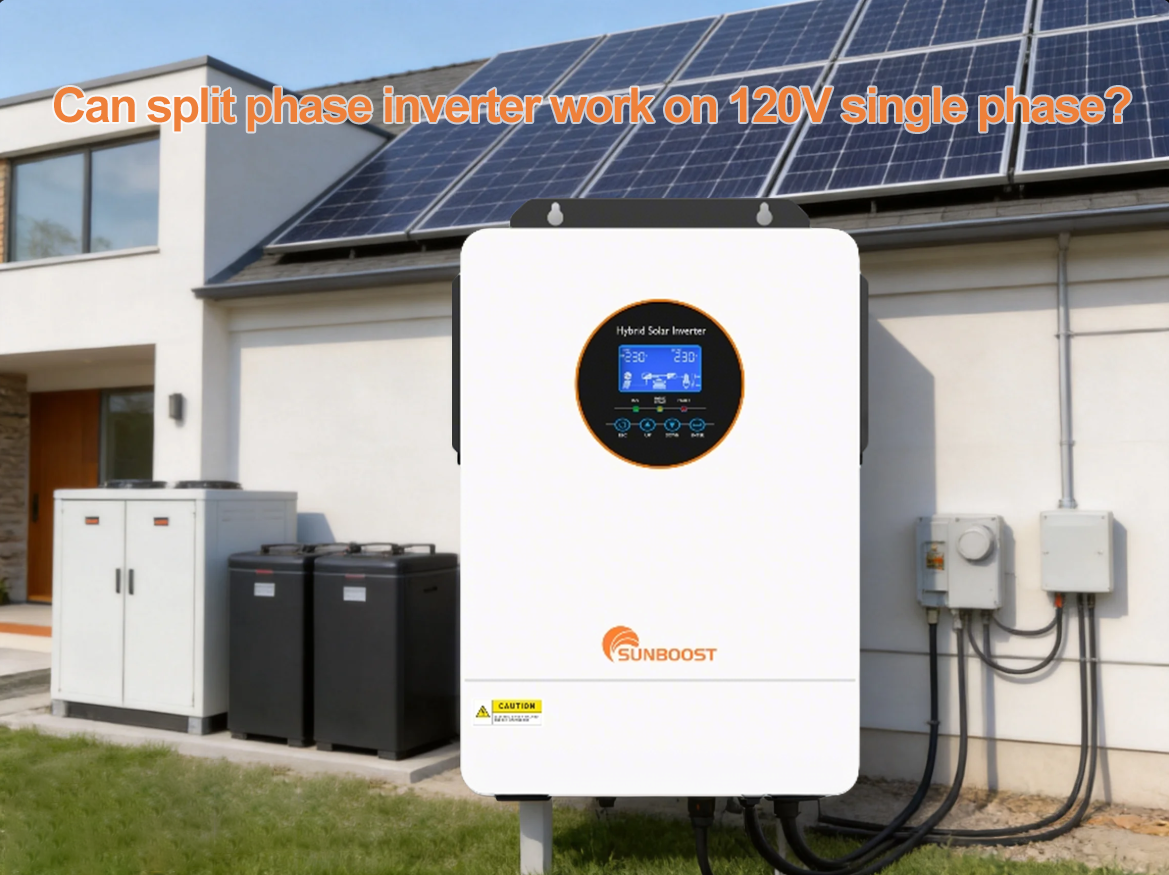
When investing in a high-performance system like the SUNBOOST 6.2KW Split Phase Inverter, one of the most common technical questions we hear is: "Can this inverter work on a 120V single-phase input?"
The answer is Yes, but there are critical technical details you need to understand about how the power shifts between input and output. Let’s dive in.
Understanding the US Power Standard: 120V vs. 240V
In a standard American household, the utility company provides two hot wires (L1 and L2) and one Neutral (N).
120V (Single Phase): Measured between either Hot wire and Neutral. This powers your standard outlets, lights, and small appliances.
240V (Split Phase): Measured between the two Hot wires (L1 to L2). This powers "heavy lifters" like your HVAC system, electric dryer, or well pump.
The magic of a split-phase inverter is its ability to handle both. But what happens when your input source—perhaps a small generator or a specific shore power connection—only provides 120V?
How a Split Phase Inverter Works?
A split-phase inverter is designed to create two 120V AC sine waves that are 180 degrees out of phase with each other. When these two waves are combined, they create 240V.
Most modern split-phase inverters feature an internal transformer or a sophisticated switching bridge that allows them to "pass through" or "bridge" power from the grid or a generator to your home’s loads.
Case Study: The SUNBOOST 6.2KW Split Phase Inverter
To make this clearer, let’s look at a practical example: the SUNBOOST 6.2KW split phase inverter, a popular choice for residential solar and off-grid systems in the US.
This inverter is designed to work with both 120V and 240V input, but its output varies significantly based on the input voltage — a detail that’s often misunderstood by homeowners.
We tested the SUNBOOST 6.2KW inverter in two scenarios to verify its input-output relationship.
In the first scenario, we connected the inverter to a 120V single-phase DC input (simulating a small solar array or a 120V backup battery system).
The results were clear: the inverter’s output was only 120V AC, available between one hot wire and the neutral. There was no 240V output between the two hot wires, as the input voltage did not provide enough potential to generate the split-phase signal.
This means that if you’re using a 120V input source, the SUNBOOST 6.2KW inverter will function like a standard single-phase inverter, powering only 120V devices — you won’t be able to run 240V appliances like electric dryers or air conditioners.
In the second scenario, we connected the inverter to a 240V input (simulating a full solar array or a 240V battery bank).
This time, the inverter produced a full 120/240V split-phase output: 120V between each hot wire and the neutral, and 240V between the two hot wires. This allowed us to power both low-voltage (120V) and high-voltage (240V) appliances, just like a standard utility connection.
We have provided illustrations for the wiring of solar panel inputs
I hope it will be helpful to our SUNBOOST customers.

The SUNBOOST 6.2KW’s built-in split-phase technology kicked in only when the input was 240V, confirming that the input voltage is the key determinant of the output.
Why is this the case? The SUNBOOST 6.2KW inverter, like most split phase inverters, is designed to match its output to its input. Its internal circuitry is configured to split the input voltage into two 120V signals only when the input is 240V.
If the input is 120V, there’s no voltage to split — the inverter simply converts the 120V DC to 120V AC, with no split-phase capability.
This is a intentional design choice, as it ensures the inverter is compatible with both 120V and 240V systems while preventing damage from mismatched voltage.
Why Choose the SUNBOOST 6.2KW Inverter?
While the input determines the output voltage in bypass mode, the SUNBOOST 6.2KW Inverter shines in its Battery Mode. Even if your grid is unstable, our inverter uses advanced power electronics to ensure your essential 120V electronics are protected and powered with a clean sine wave.
Key Advantages:
Versatility: Ideal for cabins, mobile homes, or residential backups where input power sources might vary.
LiFePO4 Optimized: Seamlessly communicates with your lithium battery bank to maximize energy storage.
Built-in Protection: Ensures that if you accidentally try to pull 240V from a 120V input, the system remains safe.
Conclusion
So, can a split-phase inverter work on 120V single phase?
Yes, it can. The SUNBOOST 6.2KW Inverter is fully capable of accepting a 120V input. However, you must remember the golden rule of inverter bypass: If you use 120V input, the output will be only 120V. It can't be 120/240V. If the input is 240V, the output will be 120/240V.
When choosing a split phase inverter, always match the input voltage to your power source (solar panels, batteries) and your needs. If you only have a 120V input and don’t need to power 240V appliances, a split phase inverter will work, but you won’t benefit from its split-phase capability. If you need to power both 120V and 240V devices, ensure your input is 240V to activate the inverter’s full split-phase functionality. With this knowledge, you can avoid costly mistakes and choose the right inverter for your home’s power needs.