


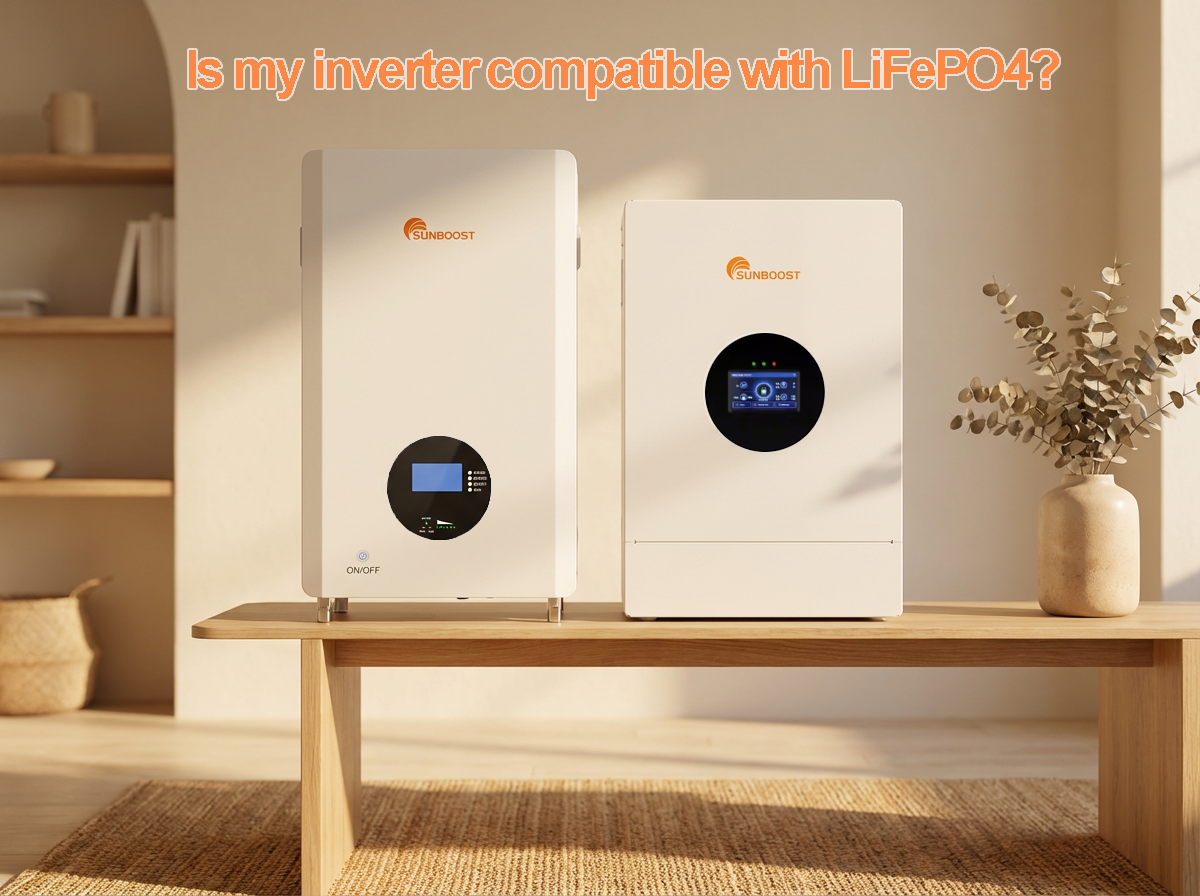
In the rapidly evolving world of renewable energy, the transition from traditional Lead-Acid batteries to LiFePO4 (Lithium Iron Phosphate) technology is no longer a luxury—it is the new industry standard. If you are transitioning from traditional Lead-Acid to Lithium, or sourcing new equipment for an off-grid project, understanding compatibility is critical for both safety and ROI.
As homeowners and businesses switch to LFP for its superior lifespan and safety, the most common question we receive at SUNBOOST is: "Is my current inverter compatible with LiFePO4 batteries?"
The short answer is: Compatibility is not just about connecting wires; it’s about communication and precision. In this guide, we will break down the science of compatibility and show you why the SUNBOOST 12KW Hybrid Inverter is the ultimate solution for your modern energy storage needs.
The Science of Compatibility: Can Your Inverter "Talk" to Your Battery's Brain?
To understand if an inverter is compatible with LiFePO4, we must look at how batteries "talk" to power electronics. Unlike Lead-Acid batteries, which are relatively "dumb" and can be charged with a simple voltage range, LiFePO4 batteries are sophisticated systems that require exact parameters.
1. The Charging Profile (The Voltage Curve)
LiFePO4 batteries have a very flat discharge curve. While a 12V Lead-Acid battery might fluctuate significantly in voltage as it drains, a LiFePO4 cell stays stable until it is almost empty.
A compatible inverter must have a dedicated LFP Charging Profile. If you use a standard Lead-Acid setting, you risk overcharging the cells or, more commonly, failing to reach a full 100% state of charge (SoC).
2. BMS Communication: The "Brain" Connection
Modern LiFePO4 batteries come with a Battery Management System (BMS). For true compatibility, the inverter and the BMS should communicate via Specified protocol. This allows the battery to tell the inverter: "I’m too cold to charge," or "I’m full, stop the current now." Without this "handshake," the inverter is essentially guessing, which can lead to premature battery degradation.
3. The Low-Voltage Cutoff
LiFePO4 batteries can be discharged much more deeply than Lead-Acid (up to 90-100% Depth of Discharge). A compatible inverter must allow you to adjust the Low-Voltage Cutoff to maximize your energy usage without triggering the battery’s internal protection circuit.
How to choose LiFePO4 batteries and inverters compatible?
First, voltage consistency is fundamental. Standard LFP nominal voltages are 12.8V (4 cells), 25.6V (8 cells) and 51.2V (16 cells), corresponding to 12V, 24V and 48V inverters.
The inverter’s DC input range must fully cover the battery’s operating voltage.
Second, power and current ratings must align. The inverter’s power (kW) should suit load demands, and the battery’s continuous discharge current must exceed the inverter’s maximum draw (current = power ÷ voltage).
Third, BMS-inverter communication is critical for safety and efficiency. Modern LFPs have a BMS monitoring voltage, temperature and SOC. Inverters supporting CAN bus or RS485 protocols enable real-time data sharing, precise charge/discharge control and fault protection.
For example: The SUNBOOST 12KW Hybrid Inverter and 48V LiFePO4 battery
it meets all three calculation scenarios above, so he can use the 48V LiFePO4 battery.
Let's first look at the key battery parameters of this SUNBOOST SPI series 12Kw inverter:

Rated battery voltage: 48Vdc (corresponding to a nominal 51.2V LiFePO4 battery pack, industry standard 16-cell lithium iron phosphate)
Battery voltage operating range: 40 ~ 60Vdc (fully covers the full charge/discharge voltage of 51.2V LFP: full charge 58.4V, full discharge approximately 40V)
Maximum charging current:
SPI-12KL: 200A
Supported battery types: Li-ion / Lead-acid / User-defined (natively supports lithium batteries, with BMS communication)
Communication interface: RS485 / CAN (supports mainstream LFP battery BMS protocols)
Why Choose SUNBOOST for Your LiFePO4 System?
1.Designed for 48V Battery Systems
The SUNBOOST 12KW model is optimized for a 48V battery architecture. Why 48V? It is the global standard for residential energy storage, offering the perfect balance between safety (low voltage) and efficiency (lower current, less heat). Whether you are using a single SUNBOOST LFP wall-mount battery or a massive rack-mounted bank, this inverter provides seamless integration.
2.Embedded Interfaces
Our 12KW inverter comes pre-loaded with communication protocols for the world’s leading LiFePO4 brands, ensuring that the BMS and Inverter work in perfect harmony from the moment you turn them on.
3.Precision Charging
We offer customizable charging stages specifically tuned for the chemical stability of Lithium Iron Phosphate, ensuring your batteries last for the promised 6,000+ cycles.
4. Built-in WiFi
In today’s connected world, you shouldn't have to walk to your garage or basement to check your energy status.
Every SUNBOOST 12KW Inverter comes with Built-in WiFi monitoring as a standard feature. Through our dedicated mobile app and web portal, you can:
Monitor real-time solar production and battery SoC.
Track your household consumption patterns.
Receive instant alerts if the system detects an anomaly.
Remote Configuration: Need to adjust your battery settings for a coming storm? You can do it from your phone, anywhere in the world.
This level of transparency ensures that you are always in control of your investment.
Conclusion
Switching to LiFePO4 (LFP) batteries requires more than just a physical connection; it demands precise communication and charging parameters. This article explores the critical roles of dedicated charging profiles, BMS-to-Inverter communication (CAN/RS485), and low-voltage cutoff settings in ensuring battery longevity.
Is your inverter compatible with LiFePO4? If you choose SUNBOOST 12KW, the answer is a resounding YES.
Contact our team today for a customized quote or technical consultation.


