The global energy landscape is shifting beneath our feet. From the rolling blackouts in California to the skyrocketing utility rates across the East Coast, homeowners are no longer just asking "how to save money on electricity"—they are asking "how to take control of it."
So you’ve decided to go solar. Great choice. But now comes the first real question: Which system is right for you?
Walk into any solar discussion, and you’ll hear three terms tossed around: on-grid, off-grid, and hybrid. They sound technical, but the logic behind them is surprisingly simple. Let’s break it down in plain English.
With the advancement of technology, hybrid inverters have emerged in the photovoltaic industry. Enter the Hybrid Revolution.at SUNBOOST, This type of inverter was also introduced.
In this comprehensive guide, We will break down the operating principles of the three types of inverters in the solar system. and show you why a Hybrid 6.2KW Inverter is the smartest investment for modern energy independence—especially when you have access to local US-based fulfillment.
On-Grid Systems: The Traditional Path
An On-Grid system is the most common residential setup. It is connected directly to your local utility grid.
The Pros:
Simplicity: No need for massive battery banks initially.
Net Metering: You can sell your excess solar energy back to the utility company for credits.
Lower Upfront Cost: Without batteries, the initial investment is significantly lower.
The Cons:
No Power During Outages: This is the "hidden" catch. For safety reasons (anti-islanding), most grid-tied inverters automatically shut down when the grid goes dark. If the neighborhood loses power, so do you—even if the sun is shining.
Reliance on Utility Policies: Changes in net metering rates (like NEM 3.0 in California) can drastically reduce your ROI.
No-Grid (Off-Grid) Systems: Total Independence
An Off-Grid system is entirely disconnected from the utility company. It relies 100% on solar panels and batteries.
The Pros:
Total Autonomy: You are immune to grid failures, utility rate hikes, and "Time-of-Use" (TOU) charges.
Energy Privacy: You generate and consume your own power without oversight from the utility.
The Cons:
High Complexity: You must size your system perfectly. If you have three days of rain and your batteries run dry, your lights go out.
Massive Battery Requirements: You need enough storage to cover your peak loads and "cloudy day" reserves.
Higher Cost: The requirement for large battery banks and specialized off-grid hardware makes this the most expensive path.
The Hybrid Solution: Why "Both" is Better than "Either"
If On-Grid is about cost-saving and Off-Grid is about independence, Hybrid is about intelligence.
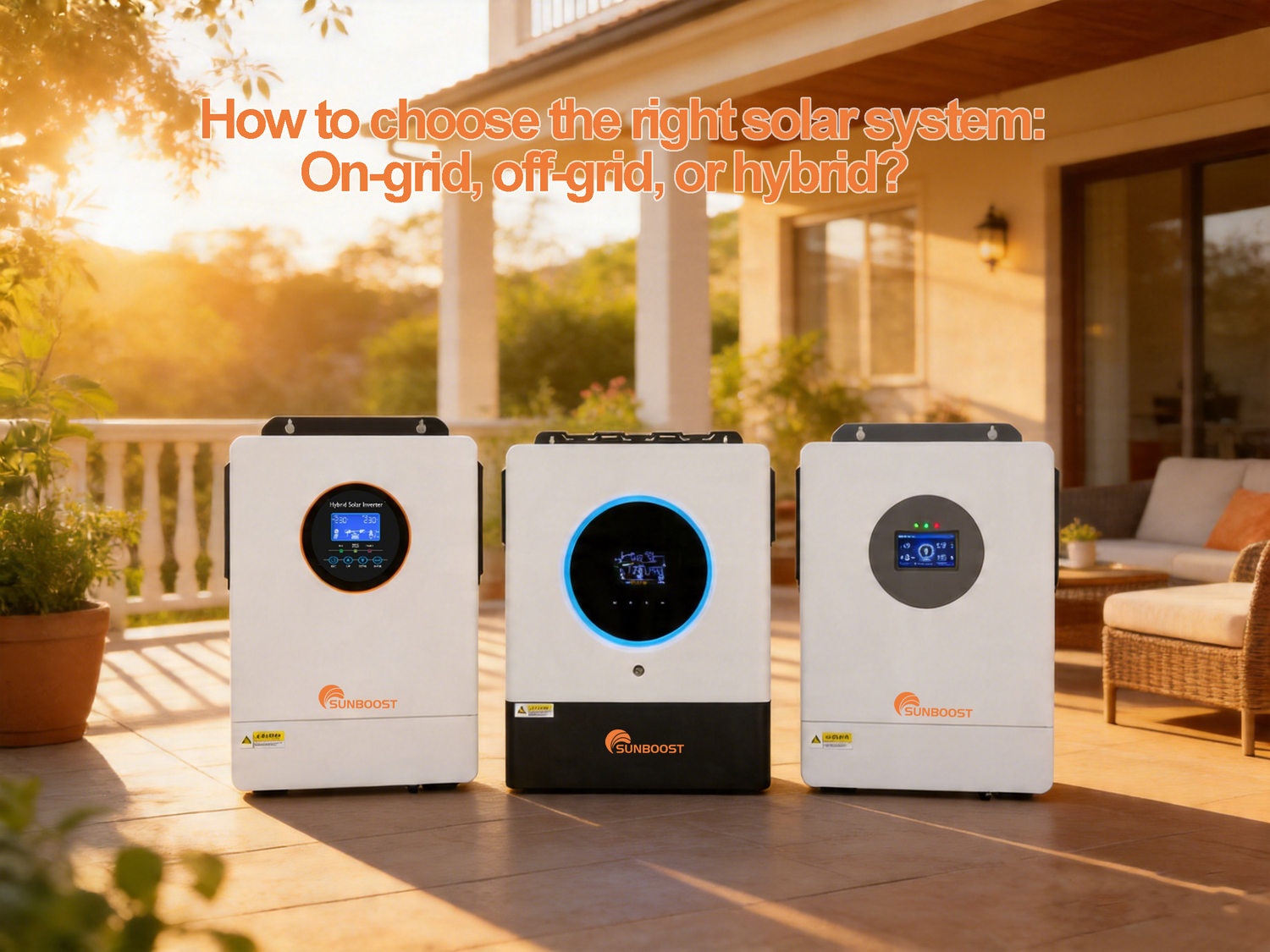
A Hybrid Inverter, like the SUNBOOST 6.2KW model, can connect to the grid, your solar panels, and your battery bank simultaneously. It acts as the "Air Traffic Controller" of your home’s energy flow.
How It Works:
During the day, the inverter powers your home with solar. If there is extra energy, it charges your LiFePO4 batteries. If the batteries are full, it sells the excess back to the grid. At night, it pulls from the batteries. If the batteries run low, it switches back to the grid.
And the best part?
You can freely select the operating mode, including solar priority mode and others.
Note: Local grid policies differ. Please contact us beforehand to check grid export eligibility at your address.(connect)
Spotlight: The SUNBOOST 6.2KW Hybrid Inverter
Returning to the original question: How to choose the right solar system
I think A hybrid SUNBOOST inverter is better because it does both.
Here is a summary of the SUNBOOST 5.5K/6.2K-D120 advantages:
Feature Benefit
6.2KW Rated Power Runs an entire small home or workshop (6200VA continuous).
99% MPPT Efficiency Extracts nearly every watt from your solar panels.
120A Discharge Supports large surge loads for well pumps/AC units.
10ms Transfer Time You won't notice a grid blackout; it switches to battery instantly.
Dust Filter Kit Long lifespan in garages, farms, or dusty industrial sites.
No Battery Required Start saving money today; add batteries next year.
BMS RS-485 Safe, smart charging for Lithium (LiFePO4) batteries.

About this 5.5/6.2K48-D120 inverter:
Important note: Engineers recommend running the inverter with battery for better safety, efficiency and compatibility.
Solar PV can charge the battery. However, the battery can only be charged by the grid when the grid voltage reaches 220V. Please check your local grid status.
Considering all aspects in advance will save you a lot of trouble.If you are unsure, feel free to message us, dear.
The SUNBOOST Advantage
The biggest frustration for US solar installers and DIY enthusiasts is waiting 4 to 8 weeks for international shipping. At SUNBOOST, we have solved this bottleneck.
1.US Warehouse: Ready to Ship
We maintain a fully stocked US Warehouse. When you order your 6.2KW Hybrid system, it isn't sitting on a boat in the middle of the Pacific—it is ready to be dispatched from our local facility.
Fast Shipping: Get your system delivered in days, not months.
Reduced Risk: No customs headaches or international shipping damage worries.
Project Timelines: Keep your installation on schedule without logistics delays.
2.Guaranteed After-Sales Service
A solar system is long investment, and you need a brand that stands by its hardware. SUNBOOST provides a comprehensive After-Sales Guarantee.
Making the Choice: Is Hybrid Right for You?
If you live in an area with:
High Electricity Rates: You can use "Peak Shaving" to avoid expensive grid power.
Unstable Grid/Storms: You need a seamless backup for your family’s safety.
Future Expansion Plans: You want to add more panels or batteries later without replacing your inverter.
Then the SUNBOOST 6.2KW Hybrid Inverter is the clear winner.
Final Recommendation
So, How to choose the right solar system? The honest answer: it depends on your situation.
Choose on-grid if you have reliable utility power, low electricity rates, and net metering available. It's the cheapest option, but remember: it will not work during a blackout.
Choose off-grid if you have no grid access (cabins, RVs, remote sites). You gain full independence, but you'll need a large battery bank and will waste excess energy when batteries are full.
Choose hybrid if you want the best of both worlds: grid backup, blackout protection, and the ability to add batteries later. Hybrids work with or without the grid, and with or without batteries.
Before buying any inverter, ask yourself three questions:
1.Does my local utility allow sending power back to the grid?
2.Do I need backup power during outages?
3.Am I ready to invest in batteries now, or later?
Thank you for reading this far. Welcome back next time. I hope this helped you.