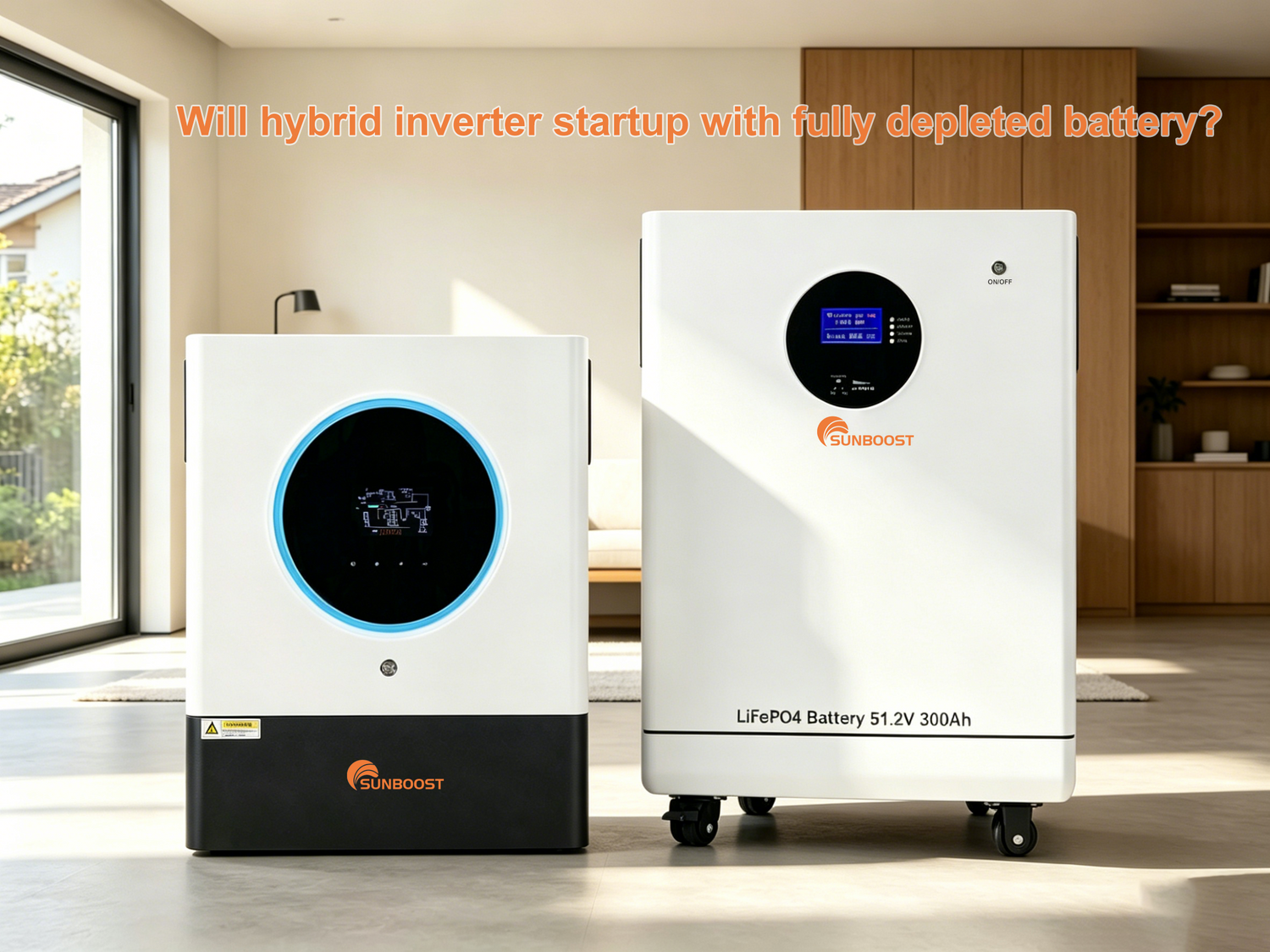
Hybrid solar inverter fails to boot after the lithium or lead-acid battery drains to zero SOC, triggering BMS undervoltage protection.This article breaks down the core logic behind this common failure, combining universal hybrid inverter operation rules and real SUNBOOST product specifications to help users self-diagnose startup faults when batteries are fully depleted.
This guide explains why fully depleted batteries block inverter startup, splits system performance by operation mode, and shares Analysis of the SUNBOOST 11KW case.
Make sure your inverter type?
If your solar battery is at 0%, you might wonder if your system can turn back on. The answer depends on your inverter’s design, but here is the general rule
1. Starting with ONLY the battery: NO
Most hybrid inverters cannot start if they only have a dead battery.
Why? The inverter has a "brain" (CPU) and a screen. These parts need a small amount of DC power from the battery to wake up.
Please see Chapter Two for details.
Safety Cut-off: When a battery is too low (e.g., below SUNBOOST 11KW 44V for a 48V system), the Battery Management System (BMS) will shut down completely to prevent damage. In this state, the inverter sees no power and cannot turn on.
2. Starting with Solar (PV) or Grid power: YES
Modern, high-end hybrid inverters can start even if the battery is empty, as long as there is an external power source.
The Feature: Quality models, such as the SUNBOOST 6.2KW, include a feature called "PV Wake-up" or "Cold Start."
How it works: As soon as the sun shines on the panels or the grid power returns, the inverter uses that energy to activate itself.
Recovery: Once the inverter is awake, it will "ping" the battery BMS to wake it up and begin a forced charge to save the battery.
If your battery is flat, don't worry—just make sure your solar panels are connected or the grid is on. The system will usually recover automatically once it detects external power.
Why can't it start? details
Inverter startup depends on the minimum battery DC voltage.
Generally speaking, most hybrid inverters cannot start up if the battery hits full depletion or enters deep-sleep protection mode triggered by BMS. Every hybrid energy storage inverter has built-in control circuits, MPPT charge controllers, LCD display screens and communication modules (WIFI, RS485, CAN). These internal components need stable low-voltage DC power to initialize before solar panels can feed power into the system.
For low-voltage storage systems, 12V battery inverters require roughly 10–11V minimum startup voltage;
24V systems demand higher thresholds, while mainstream 48V hybrid inverters like SUNBOOST 11KW set a fixed cold start voltage at 44VDC. When the battery discharges below this threshold, the battery management system cuts off output to prevent irreversible deep discharge damage to lead-acid, AGM or lithium batteries. Once BMS undervoltage protection activates, the inverter loses its core DC power supply and cannot boot, no matter how much power your solar photovoltaic array generates.
Solar panels only supply variable DC power affected by sunlight intensity, cloud cover and time of day. Fluctuating PV voltage cannot replace a battery as a stable DC bus reference for hybrid inverters, which is why pure PV cold start without battery support is not supported by most mainstream residential solar inverters.
In short, using a battery-powered inverter results in a more stable current.
Two System Modes Lead
The actual startup performance of your solar setup depends entirely on your inverter type and grid connection status, divided into off-grid battery-dependent mode and grid-tied bypass mode
1.Off-Grid & Battery-Dependent Solar Systems
In remote off-grid cabins, holiday houses or scenarios with complete grid outages, the hybrid inverter fully depends on battery power for initialization. When the battery drains to zero SOC and BMS locks output, the inverter pops up an under-voltage error code and stays shut down. Even if the sun rises and solar panels produce maximum rated power, the MPPT module cannot activate without the battery’s stable reference voltage.
Take SUNBOOST MAXII 11KW(11000W 48V hybrid inverter) as an example: its PV maximum open circuit voltage reaches 500VDC, with a 90–450VDC MPPT working range and 80V PV startup voltage. The solar panel array can generate DC power as long as sunlight meets the threshold, yet the entire MPPT charging circuit remains inactive without the battery hitting the 44VDC cold start requirement. Off-grid users with dead batteries cannot rely solely on solar panels to restart the inverter.

2. Grid-Tied Hybrid Inverters With Bypass Function
Grid-connected hybrid inverters carry a built-in bypass mode that solves the dead-battery startup problem. When the battery is fully depleted, the inverter switches to bypass state automatically, drawing stable AC power from the utility grid. Grid electricity serves two critical functions: it supplies auxiliary power to the inverter’s mainboard, and delivers low-current trickle charging to the battery bank.
Gradually, the battery voltage climbs back to the cold start threshold (44VDC for SUNBOOST MAXII series). Once the battery meets the startup parameter, the inverter exits bypass mode, activates MPPT solar charging, and resumes normal off-grid energy storage operation. This bypass feature is a standard configuration for SUNBOOST 11KW, greatly reducing downtime caused by accidental full battery discharge for households connected to the grid.
Troubleshooting methods when the battery is at 0%
Based on SUNBOOST hybrid inverter specifications and industry-wide solar troubleshooting standards, here are three targeted fixes for users stuck with an unbootable inverter after battery drain:
Grid-Tied Users: Utilize Built-In Bypass Mode
Keep the inverter connected to mains power. The bypass circuit will slowly recharge the battery without extra operation. After 2–6 hours of trickle charging, battery voltage will recover above 44VDC, and the inverter will start normally.
Off-Grid Users Without Grid Access: Auxiliary Charging Top-Up
Use an external battery charger to boost the depleted battery voltage to over 44VDC (for 48V inverters). After reaching cold start voltage, turn on the inverter; solar panels will take over continuous charging once the MPPT module initializes.
Preventative Maintenance To Avoid Zero SOC Discharge
Set reasonable low voltage cut-off values on the inverter’s BMS menu to stop deep discharge. Match solar panel array power to daily load consumption to avoid over-draining batteries during cloudy weather. SUNBOOST MAXII inverters support customizable battery protection parameters via WIFI monitoring app for long-term battery health management.
SUNBOOST 11KW inverters set 29 items

Final
hybrid inverters cannot start with a fully depleted battery in off-grid mode, as internal circuits require stable battery DC voltage to initialize, and solar panel power alone cannot act as a reliable DC bus reference.
Grid-tied hybrid inverters with bypass function can recover automatically by drawing grid power to recharge dead batteries to cold start voltage.
Before purchasing solar energy storage equipment, we should check key parameters including cold start voltage, bypass mode support and PV cold start function.
I hope we can make progress together through reading.Thank you for watching.