An inverter is the core component of any solar or backup power system, converting DC power from batteries or solar panels into usable AC power for household and commercial appliances.
When selecting an inverter, you may come across the comparison between low-frequency and high-frequency designs. Understanding their differences is key to choosing a system that aligns with your needs.
At SUNBOOST, we break down both technologies, focusing on performance, efficiency, and real-world application.
What Does “Frequency” Mean in an Inverter?
The term “frequency” in this context refers to the internal switching speed of the inverter’s electronics—the rate at which it converts DC to AC power. This is distinct from the output AC frequency (50Hz/60Hz), which is fixed to match local grid standards.
1.Low-frequency inverters: Operate at the same 50/60Hz as the grid, relying on large, heavy-duty iron-core transformers for power conversion.
2.High-frequency inverters: Use advanced semiconductor technology to switch at much higher speeds (20kHz to 100kHz), enabling more compact and efficient designs.
What Are Low-Frequency Inverters?
Low-frequency inverters are the traditional design, built around large, heavy-duty transformers. These transformers operate at the grid’s 50/60Hz frequency, making them robust for heavy loads.
Pros
✅ Strong surge capacity (2–5x rated power) to start inductive loads like AC units, pumps, and motors
✅ Rugged build for industrial or off-grid use
✅ Long lifespan in constant heavy-load scenarios
Cons
❌ Bulky and heavy, making them hard to install in tight spaces
❌ Lower efficiency at light to medium loads, wasting energy
❌ Higher upfront cost due to large transformers
What Are High-Frequency Inverters?
High-frequency inverters use modern switching technology to convert power more efficiently. Instead of large transformers, they rely on compact semiconductors (MOSFETs/IGBTs), making them smaller, lighter, and smarter.
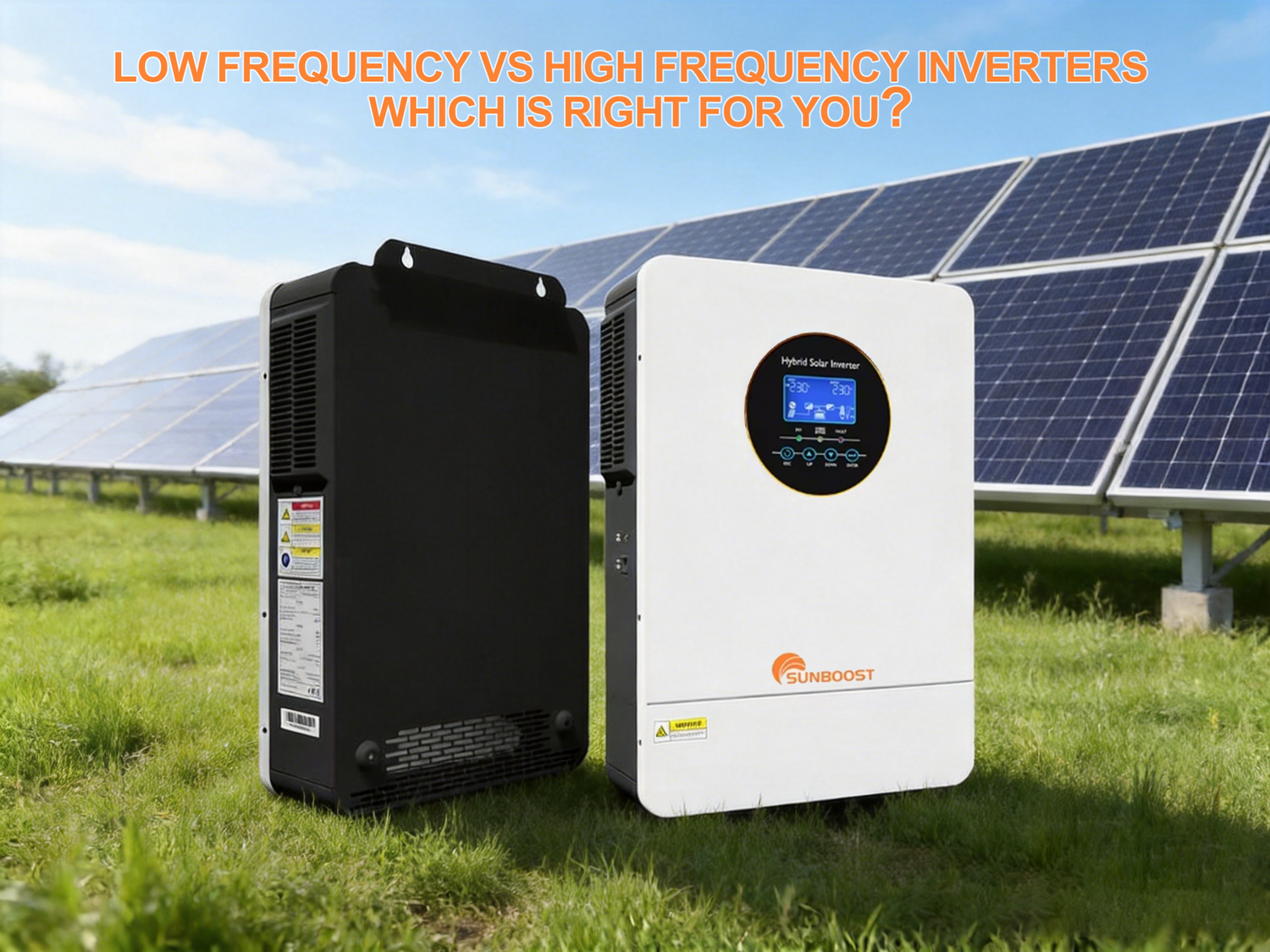
At SUNBOOST, our hybrid inverters (including 5.5kW/6.2kW split-phase models) are high-frequency devices. Currently, high-frequency inverters operate very stably and are much more efficient than low-frequency inverters.
Key Advantages of SUNBOOST High-Frequency Inverters
✅ High efficiency (up to 99%): Our advanced MPPT and switching tech minimizes energy loss, especially at typical household loads.
✅ Compact & lightweight: Easy wall-mounted installation, perfect for homes with limited space.
✅ Affordable yet reliable: Modern components keep costs down without sacrificing performance.
✅ Quiet operation: No noisy large transformers, making them ideal for living spaces.
✅ Smart connectivity: Built-in Wi-Fi/BMS communication for remote monitoring and seamless battery integration.
Common Myths About High-Frequency Inverters
Some users worry high-frequency inverters can’t handle heavy loads – but this is outdated thinking. SUNBOOST’s latest high-frequency inverters use optimized heat dissipation and surge protection to deliver stable power even for refrigerators, air conditioners, and other inductive appliances. With peak efficiency of 99% and a 10ms transfer time, they perform reliably for both daily use and backup scenarios.

Feature: Low-Frequency Inverters VS SUNBOOST High-Frequency Inverters
Size & Weight: Bulky, heavy VS Compact, lightweight
Efficiency: Lower at light loads VS Up to 99% efficient for all typical loads Surge
Capacity: 2–5x rated power VS Optimized for stable, controlled
Surges Durability : Good for constant heavy use VS Rugged for home/commercial use, with smart cooling
Cost: Higher upfront cost VS Budget-friendly, with better long-term savings
Use Cases: Industrial, heavy-duty off-grid VS Homes, small businesses, RVs, solar backup
Which Should You Choose?
Choose a Low-Frequency Inverter If
1.You’re powering industrial machinery or extremely heavy, continuous loads.
2.You operate in a remote, off-grid setting with no space constraints.
Choose a SUNBOOST High-Frequency Inverter If
1.You need a reliable inverter for home use, including AC units, refrigerators, and daily appliances.
2.Space and installation ease are priorities (wall-mounted design).
3.You want maximum efficiency to reduce energy bills.
4.You need smart connectivity for monitoring and battery integration.
Our 5.5kW/6.2kW split-phase high-frequency inverters are ideal for North American and global homes, supporting both 120V and 240V outputs, with compatibility for 48V lithium batteries. They handle light and heavy loads efficiently, making them a future-proof choice for solar and backup systems.
Conclusion
The low vs. high frequency debate no longer boils down to “one is better than the other.” For most residential and small commercial users, high-frequency inverters offer the best balance of efficiency, performance, and value.
SUNBOOST high-frequency inverters deliver stable, pure sine wave power, 99% efficiency, and smart features at a competitive price. They’re built to handle the demands of modern households while being easy to install and maintain.
Whether you’re building a new solar system or upgrading your backup power, SUNBOOST high-frequency inverters provide reliable, efficient power that fits your needs – without the bulk and inefficiency of older low-frequency designs.
If you’re ready to upgrade, contact us to learn more about our 5.5kW/6.2kW hybrid inverters and how they can power your home.
I hope to be of help to you,Thanks for watching.